
 Facebook
 X
 Pinterest
 Copy Link
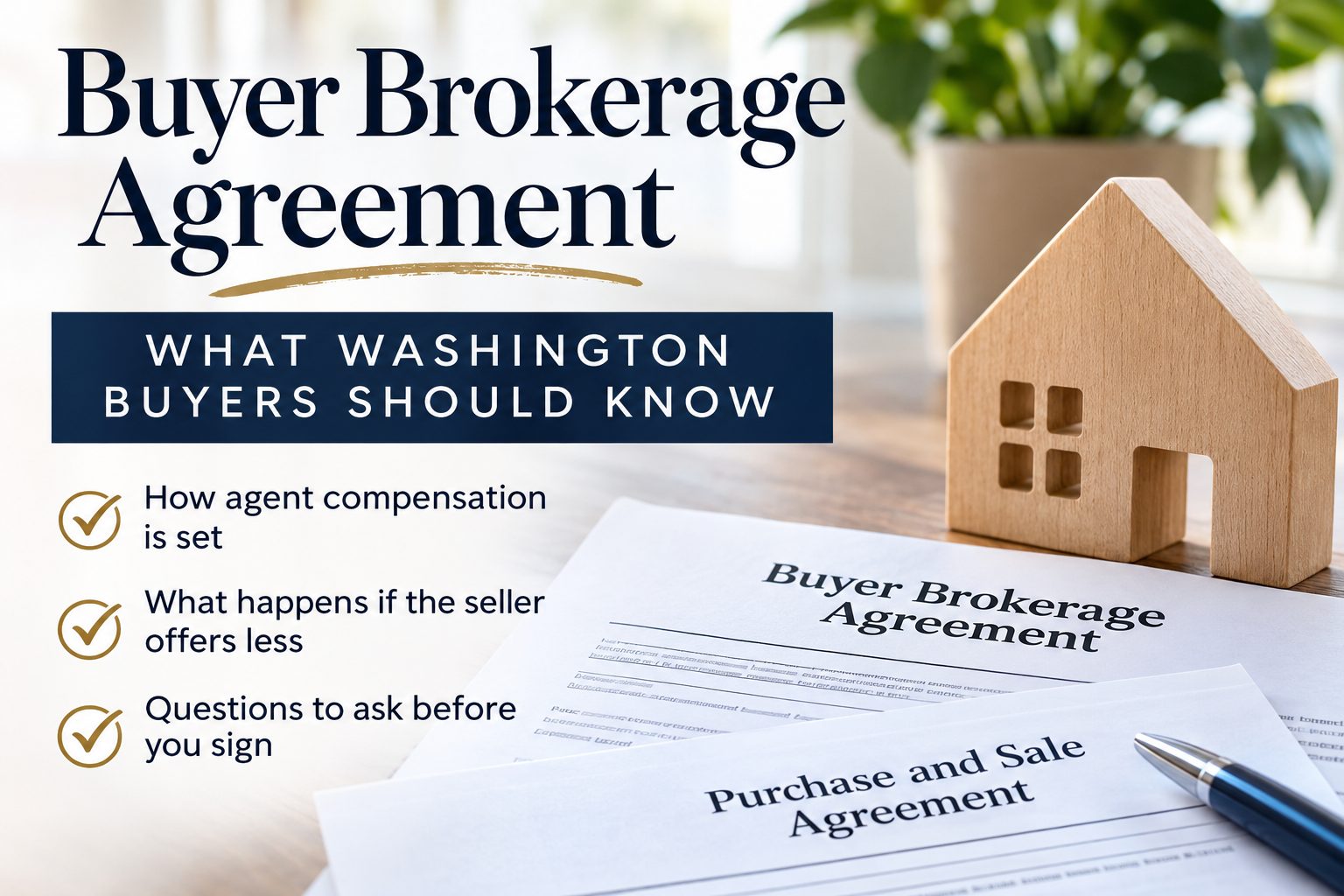
Before you sign an agreement with a real estate broker, there is one important conversation you should have: How will your broker get paid, and what happens if the seller offers less?
When you decide to purchase a home in Washington, you will sign a Buyer Brokerage Services Agreement with the real estate firm representing you.
This agreement explains your relationship with the broker, the services they will provide, and how much the firm will be paid.
However, there is one section I believe every buyer should understand before signing.
Section 5: Understanding Your Broker’s Compensation
Section 5 of the Buyer Brokerage Services Agreement outlines the compensation you and your broker agree upon.
Let’s say you agree to pay your buyer’s brokerage firm 2.5% of the home’s purchase price.
If the seller agrees to pay that full amount, great! The seller’s payment can satisfy your agreed compensation obligation.
But what happens if the seller offers only 1.75%?
This is where things can become confusing for buyers.
Depending on your agreement and the terms negotiated, your broker may have several options.
- Accept the 1.75% offered by the seller and agree to reduce the compensation.
- Request that the seller pay a higher amount.
- Ask you to pay the difference between the seller’s contribution and the agreed compensation.
The important thing to understand is that the seller is not required to pay your buyer’s broker.
And just as importantly, real estate compensation is negotiable. There is no standard commission rate.
What Does Line 17 of the Purchase and Sale Agreement Mean?
When you make an offer on a home, the Purchase and Sale Agreement includes a section addressing buyer brokerage compensation.
Using the example shown in the forms:
Line 17(a): Seller’s Offer of Compensation
This identifies the compensation the seller is offering toward the buyer’s brokerage firm.
For example, the seller may offer 1.75%.
Line 17(b): Amount to Be Paid by Seller
This identifies the amount requested for the seller to pay in the buyer’s offer.
The two numbers do not always have to match.
For example, a seller might offer 1.75%, but the buyer’s offer could request 2.5%.
That difference becomes another term for the seller to consider when reviewing the offer.
The seller can agree, reject the request, or negotiate different terms.
Why Should Buyers Pay Attention?
Let’s look at a simple example.
You find a home you absolutely love listed for $600,000.
Your Buyer Brokerage Services Agreement specifies 2.5% compensation.
However, the seller is offering 1.75%.
Here’s the difference:
- Agreed brokerage compensation at 2.5%: $15,000
- Seller’s offered compensation at 1.75%: $10,500
- Difference: $4,500
Your broker could request that the seller pay the additional $4,500.
However, that request becomes part of the overall offer the seller is evaluating.
And depending on the circumstances, it could affect the seller’s decision.
This doesn’t mean requesting additional compensation is always the wrong choice. But it does mean you should understand what is being negotiated and why.
Is Your Broker Negotiating for You or for Their Compensation?
This is the question I want buyers to think about.
When you hire a real estate broker, you are trusting that person to represent your interests throughout one of the largest purchases you may ever make.
Your broker should be helping you negotiate the purchase price, inspection terms, closing costs, timelines, and other important details.
But what happens when the broker’s compensation also becomes part of those negotiations?
There may be situations where a broker is requesting additional compensation from the seller while the buyer doesn’t fully understand that request.
And that is where transparency matters.
For example, would you want to know that your broker could accept the seller’s offered compensation rather than request additional money?
Would you want to understand how that decision could affect the strength of your offer?
I believe the answer is yes.
Buyers deserve to know when a negotiation involves their broker’s compensation, not just the purchase of their home.
Why Would a Seller Offer Less Compensation?
There are several reasons a seller may offer a particular amount.
The seller may have financial obligations, limited equity, or specific net proceeds they need from the sale.
They may also have negotiated their own brokerage fees and decided how much they are comfortable contributing toward the buyer’s representation.
Every seller’s situation is different.
Offering less compensation does not necessarily mean the seller is unwilling to negotiate or that they don’t want to sell their home.
It simply means compensation is one part of the overall transaction.
Five Questions Every Buyer Should Ask Their Broker
Before signing your Buyer Brokerage Services Agreement, I encourage you to ask:
- What percentage or amount am I agreeing to pay your brokerage firm?
- What happens if the seller offers less than the amount in our agreement?
- Am I responsible for paying the difference?
- Would you consider accepting a lower amount if it helped me purchase the home I want?
- Will you explain any compensation requests before we submit an offer?
These are fair questions.
And your broker should be comfortable answering them.
Kolleen’s Perspective
I believe a strong relationship between a buyer and their real estate broker starts with trust, communication, and transparency.
Real estate brokers deserve to be compensated for the services they provide. Representing a buyer involves time, knowledge, responsibility, and a great deal of work behind the scenes.
However, I also believe buyers deserve to understand exactly what they are agreeing to and how compensation may affect negotiations.
There may be times when a broker chooses to accept less compensation to help a transaction come together. There may also be situations where negotiating additional compensation makes sense.
What matters is that the buyer understands the options and has a voice in the decision.
At the end of the day, your real estate broker is there to represent you and help you achieve your real estate goals.
Before signing any agreement, ask questions. Understand the terms. And make sure you feel confident that the person representing you is putting your interests first.
Because buying a home should be about finding the right home and making informed decisions along the way.
